English student.com
Sunday, November 25, 2012
Top 10 Picture Books for the Secondary Classroom by Kim McCollum-Clark
As a teacher of future English teachers, I am always trying to open my students’ eyes to the wonder and power of the picture book, both as an art form and as a terrific instructional tool for the secondary classroom. Being students of capital-L literature, my teacher-babies sometimes forget to consider these compact and powerful texts. It’s the best way I know to get numerous, diverse and COMPLETE texts into students’ minds.
It’s hard enough to squeeze out the time in the overcrowded middle and high school English curriculum to read young adult and classic novels, but with picture books, you can read the entire work aloud, model the focus you want students to concentrate on, let them explore the craft, have the discussion, and even try it out in their own writing–all in one period! Secondary teachers can use picture books in so many ways: as writing prompts, as mentor texts for craft and genre study, as “ways in” to thematic units, as complete texts for close literary analysis or application of different critical lenses. And the amazing power of the best picture books, I argue, is as “literary” as the most la-ti-dah text on your shelf already. They were carefully and purposefully constructed by multiple artists: the author, illustrator, and book designer, at the very least.
So here, in no particular order: my top ten.

1. Amos and Boris, written and illustrated by William Steig. I use this story of an unusual friendship for discussions of sentence length/variety and style. I ask students to imitate (in the rhetorical sense, of writing their own sentences in the same syntax and sentence length) various passages to experiment with Steig’s cadences.

2. Where the Wild Things Are, written and illustrated by Maurice Sendak. This classic picture book is perfect for exploring layers of meaning in a literary criticism exercise. Because students “know” the book, they are amazed when they start unpacking the details of the books’ construction and the significance of Sendak’s choices.

3. Fox, written by Margaret Wild and illustrated by Ron Brooks. This slight text is a rich and inventive allegory about relationships. It will stimulate discussion and even arguments about the book’s theme. Brooks’ art is intense and worth careful consideration. Students will re-read and look carefully to support their positions.
4. An Angel for Solomon Singer, written by Cynthia Rylant and illustrated by Peter Catalanotto. I include this book to get the magical Cynthia Rylant and all her works in my students’ hands. Rylant’s character study of a city diner is a wonderful evocation of character and setting.
5. Orville, A Dog Story, written by Haven Kimmel and illustrated by Robert Andrew Parker. Judy Schachner (of Skippyjon Jones fame) read this book aloud to us at the PA Writing Institute in 2010, and many participants – adult teachers – had to excuse themselves because its emotional power was so great. A perfect short story in picture book form.

6. Voices in the Park, written and illustrated by Anthony Browne. Four people come into the park; four distinct voices narrate what happened there. A terrific book for teaching perspective/point of view for reading and voice in writing.

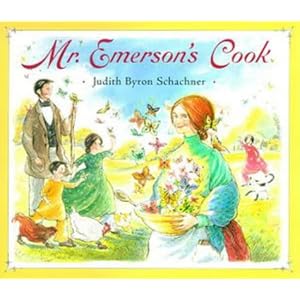
7. Mr. Emerson’s Cook, written and illustrated by Judy Schachner, is a biographical picture book inspired by Schachner’s great grandmother, cook to the writer and philosopher Ralph Waldo Emerson. This book helps describe Emerson’s Transcendalist views. Also great to explore how facts and research are woven into fiction.

8. Rose Blanche, written by Roberto Innocenti and illustrated by Christophe Gallaz, is a story set in the Holocaust about a German girl who tries to help the children in the concentration camp close to her home. Also an allegory of the White Rose (Rose Blanche) student movement that tried to resist Hitler. A good opportunity for a bit of research and an exploration of the power of allegory. Why can’t we tell every story “straight”?
9. Flotsam, written and illustrated by David Wiesner, is the story of one boy’s unbelievable beach adventure. Wiesner, a three-time Caldecott winner, “writes” and paints wordless books. His immersive artwork is a delight of the imagination, and somehow he conveys plot, character, theme and a wonderful sense of humor in his art. My sons had to help me decide which Wiesner title was “the best,” so check them all out!

10. A Kick in the Head: An Everyday Guide to Poetic Forms, written by Paul Janeczko and illustrated by Chris Raschka, is a kinetic work of art describing twenty-nine different poetic forms in prose and amazing illustrations. The book goes way beyond sonnets and haikus, and best of all, suggests how a poet might choose a poetic form to match his or her poetic intention. Janeczko is one of my favorite anthologists of contemporary poetry and Raschka is a wonderful, wild-child illustrator. This book is one of a trilogy, and I recommend them all!
Nerdy friends, you are never too old for picture books–I feel like you know that! But go forth and spread the word of their amazing literary power, the purposefulness of their construction, the beauty of their craft, and their utility in EVERY classroom. These amazing masters, both wordsmiths and visual artists, can light up our reading and writing lives
It’s hard enough to squeeze out the time in the overcrowded middle and high school English curriculum to read young adult and classic novels, but with picture books, you can read the entire work aloud, model the focus you want students to concentrate on, let them explore the craft, have the discussion, and even try it out in their own writing–all in one period! Secondary teachers can use picture books in so many ways: as writing prompts, as mentor texts for craft and genre study, as “ways in” to thematic units, as complete texts for close literary analysis or application of different critical lenses. And the amazing power of the best picture books, I argue, is as “literary” as the most la-ti-dah text on your shelf already. They were carefully and purposefully constructed by multiple artists: the author, illustrator, and book designer, at the very least.
So here, in no particular order: my top ten.
1. Amos and Boris, written and illustrated by William Steig. I use this story of an unusual friendship for discussions of sentence length/variety and style. I ask students to imitate (in the rhetorical sense, of writing their own sentences in the same syntax and sentence length) various passages to experiment with Steig’s cadences.
2. Where the Wild Things Are, written and illustrated by Maurice Sendak. This classic picture book is perfect for exploring layers of meaning in a literary criticism exercise. Because students “know” the book, they are amazed when they start unpacking the details of the books’ construction and the significance of Sendak’s choices.
3. Fox, written by Margaret Wild and illustrated by Ron Brooks. This slight text is a rich and inventive allegory about relationships. It will stimulate discussion and even arguments about the book’s theme. Brooks’ art is intense and worth careful consideration. Students will re-read and look carefully to support their positions.
4. An Angel for Solomon Singer, written by Cynthia Rylant and illustrated by Peter Catalanotto. I include this book to get the magical Cynthia Rylant and all her works in my students’ hands. Rylant’s character study of a city diner is a wonderful evocation of character and setting.
5. Orville, A Dog Story, written by Haven Kimmel and illustrated by Robert Andrew Parker. Judy Schachner (of Skippyjon Jones fame) read this book aloud to us at the PA Writing Institute in 2010, and many participants – adult teachers – had to excuse themselves because its emotional power was so great. A perfect short story in picture book form.
6. Voices in the Park, written and illustrated by Anthony Browne. Four people come into the park; four distinct voices narrate what happened there. A terrific book for teaching perspective/point of view for reading and voice in writing.
7. Mr. Emerson’s Cook, written and illustrated by Judy Schachner, is a biographical picture book inspired by Schachner’s great grandmother, cook to the writer and philosopher Ralph Waldo Emerson. This book helps describe Emerson’s Transcendalist views. Also great to explore how facts and research are woven into fiction.
8. Rose Blanche, written by Roberto Innocenti and illustrated by Christophe Gallaz, is a story set in the Holocaust about a German girl who tries to help the children in the concentration camp close to her home. Also an allegory of the White Rose (Rose Blanche) student movement that tried to resist Hitler. A good opportunity for a bit of research and an exploration of the power of allegory. Why can’t we tell every story “straight”?
9. Flotsam, written and illustrated by David Wiesner, is the story of one boy’s unbelievable beach adventure. Wiesner, a three-time Caldecott winner, “writes” and paints wordless books. His immersive artwork is a delight of the imagination, and somehow he conveys plot, character, theme and a wonderful sense of humor in his art. My sons had to help me decide which Wiesner title was “the best,” so check them all out!
10. A Kick in the Head: An Everyday Guide to Poetic Forms, written by Paul Janeczko and illustrated by Chris Raschka, is a kinetic work of art describing twenty-nine different poetic forms in prose and amazing illustrations. The book goes way beyond sonnets and haikus, and best of all, suggests how a poet might choose a poetic form to match his or her poetic intention. Janeczko is one of my favorite anthologists of contemporary poetry and Raschka is a wonderful, wild-child illustrator. This book is one of a trilogy, and I recommend them all!
Nerdy friends, you are never too old for picture books–I feel like you know that! But go forth and spread the word of their amazing literary power, the purposefulness of their construction, the beauty of their craft, and their utility in EVERY classroom. These amazing masters, both wordsmiths and visual artists, can light up our reading and writing lives
Instructional technology
Instructional technology is considered as a
teaching aids .And a teaching aids is a tool used
by teachers or tutors to
facilitate learning and help learners improve their reading and other skills
.So that , instructional technology focuses on using computer ,internet, CD,
ROMS, modems and other technological means to support learning and improve
classroom learning . As well as, it helps to illustrate or reinforce a skill,
fact, or idea and reduce anxiety, fears, or boredom of students, since many
teaching aids are like games.
What are writing skills?
|
Introduction | |
| Writing skills help the learner gain independence, compreheensibility, fluency and creativity in writing. If learners have mastered these skills, they will be able to write so that not only they can read what they have written, but other speakers of that language can read and understand it. | |
Definition | |
| Writing skills are specific abilities which help writers put their thoughts into words in a meaningful form and to mentally interact with the message. | |
| Discussion | |
| Here are some writing goals as defined by Hampton 1989 : | |
| |
| Kinds | |
| Here are some kinds of writing skills: | |
http://www.arab4load.info/downloadf-6eb41353858327181-pdf.html | |
Short Essay on Friendship
Friendship is a feeling of love and affection of one person for another. This feeling of love must be reciprocated. Otherwise friendship cannot be possible. Friendship does not exist where tastes, feelings and sentiments are not similar.
The famous essayist Bacon has warned against the friendship between a very rich person and a very poor person. Economic disparity damages friendship. Thus friendship is a feeling of affection between two likeminded persons of uniform status.It is said that a friend in need is a friend in deed. There may be many friends at the time of prosperity. But most of them desert at the time of adversity. We can examine the sincerity of a friend during our time of hardship and trouble. Only a sincere and faithful friend remains with us at the time of our trouble. All others leave us. It is very painful when our friends turn traitors.
Money is an enemy of friendship. Everybody has an attraction for money. When lending or borrowing of money is done between two friends, there is great risk. Friendship may be affected. So it is wise for true friends to avoid monetary transaction. Vanity is another element which breaks friendship. Everybody has self-respect. When a person tries to criticise his friend, their friendship is affected. So friendship must be treated very delicately.
Very often some hypocrites pretend to be friends. They are more dangerous than avowed enemies. By telling soft words they bring enormous ruin to us. A true friend never exploits. He rather surrenders. But at present, the meaning of friendship has changed.
There are many fair-weathered friends. They terminate their friendly tie as soon as their interests are fulfilled. It is very difficult to find a true friend today. It is better to establish true friendship with either a dog or an elephant. Both these beasts will remain faithful to their human friends. Today, friendship between two persons is short-lived.
Good friends exercise good influence. They always help their friends, in distress and inspire them to walk on the right path. But evil friends ruin us completely.
http://www.arab4load.info/downloadf-4b2f1353913652441-ppt.html
http://www.arab4load.info/downloadf-c3941353855062641-pdf.html
There are three important exceptions:
Look at these examples with the main verb be. Notice that there is no auxiliary:
Look at these examples:
Present Simple Tense
How do we make the Present Simple Tense?
| subject | + | auxiliary verb | + | main verb |
| do | base |
- For positive sentences, we do not normally use the auxiliary.
- For the 3rd person singular (he, she, it), we add s to the main verb or es to the auxiliary.
- For the verb to be, we do not use an auxiliary, even for questions and negatives.
| subject | auxiliary verb | main verb | |||
| + | I, you, we, they | like | coffee. | ||
| He, she, it | likes | coffee. | |||
| - | I, you, we, they | do | not | like | coffee. |
| He, she, it | does | not | like | coffee. | |
| ? | Do | I, you, we, they | like | coffee? | |
| Does | he, she, it | like | coffee? |
| subject | main verb | |||
| + | I | am | French. | |
| You, we, they | are | French. | ||
| He, she, it | is | French. | ||
| - | I | am | not | old. |
| You, we, they | are | not | old. | |
| He, she, it | is | not | old. | |
| ? | Am | I | late? | |
| Are | you, we, they | late? | ||
| Is | he, she, it | late? |
How do we use the Present Simple Tense?
We use the present simple tense when:- the action is general
- the action happens all the time, or habitually, in the past, present and future
- the action is not only happening now
- the statement is always true
| John drives a taxi. | ||
| past | present | future |
| It is John's job to drive a taxi. He does it every day. Past, present and future. | ||
- I live in New York.
- The Moon goes round the Earth.
- John drives a taxi.
- He does not drive a bus.
- We meet every Thursday.
- We do not work at night.
- Do you play football?
| Am I right? Tara is not at home. You are happy. | ||
| past | present | future |
| The situation is now. | ||
| I am not fat. Why are you so beautiful? Ram is tall. | ||
| past | present | future |
| The situation is general. Past, present and future. | ||
Subscribe to:
Posts (Atom)